
Patellar tendinitis treatment: 7 physical therapy methods that can support recovery

Does your knee hurt when you jump, squat or run? Is the pain triggered by movements that should be easy, like standing up after sitting? If your pain is just below the kneecap, patellar tendinitis may be part of the issue.
Patellar tendinitis, also spelled “tendonitis,” can happen when the patellar tendon is placed under more stress than it is ready to handle. This tendon connects your kneecap to your shinbone and helps your leg straighten when you walk, run, climb stairs or jump.
This condition is also known as “jumper’s knee.”
Patellar tendinitis treatment often includes physical therapy. A physical therapist at one of KC Rehab’s locations may help reduce pain, improve strength and return to the activities you enjoy.
What does patellar tendinitis feel like?
Patellar tendinitis usually causes pain at the front of the knee, near the lower edge of the kneecap. At first, symptoms may show up only during or after strenuous activity. Over time, pain may interfere with daily tasks.
Common symptoms include:
Tenderness near the patellar tendon
Knee stiffness after sitting or resting
Pain with stairs, squats, running or jumping
A feeling of weakness in the knee
If these symptoms don’t sound like you, a physical therapist may still be able to address knee pain. Your pain may stem from a variety of causes, including arthritis, ligament injury, meniscus irritation or movement problems at the hip, ankle or foot.
Why physical therapy can help you with patellar tendinitis
Rest may calm symptoms for a short time, but activity might cause pain to return if the tendon and surrounding muscles are not ready. Physical therapy may help you prepare to move comfortably again.
A physical therapist may begin by looking at:
Knee movement
Hip, ankle and foot mechanics
Muscle strength
Flexibility
Balance and control
Activities that trigger pain
From there, your physical therapist can build a treatment plan.
7 physical therapy methods that can support recovery
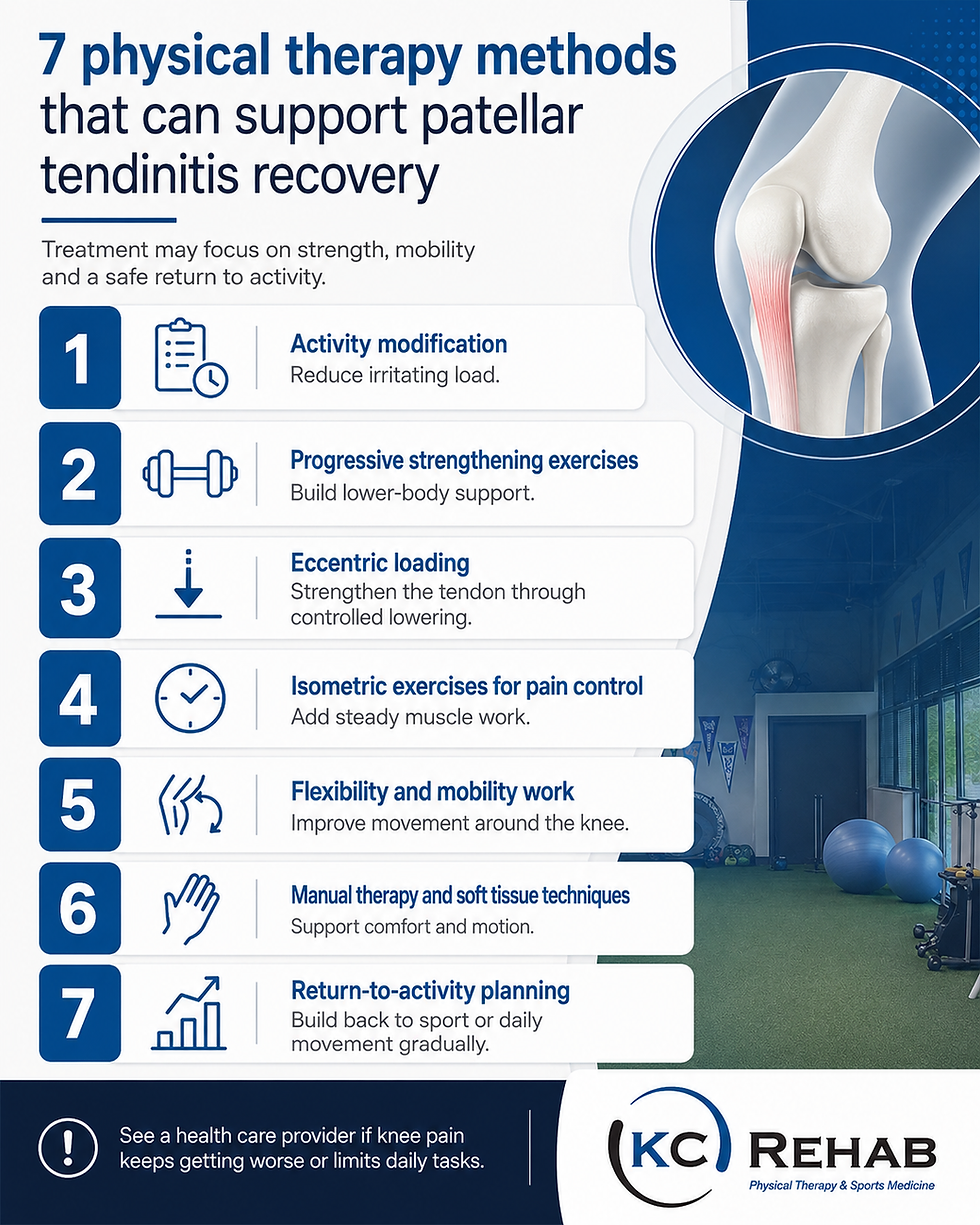
Activity modification
Activity modification means adjusting movement so your tendon can recover without losing too much strength or fitness. It does not always mean stopping all activity.
Your physical therapist may help you adjust:
Running mileage
Jumping or cutting drills
Squats and lunges
Work tasks that involve stairs or kneeling
Exercises that increase pain
The goal is to reduce painful overload while keeping you moving in a safe way.
2. Progressive strengthening exercises
Strengthening is a key part of patellar tendinitis treatment. Weakness in the thigh, hip or calf can increase stress on the patellar tendon.
Your physical therapist may focus on strengthening the:
Core muscles
Glutes
Quadriceps
Hamstrings
Calves
Your plan may start with gentle exercises and become more challenging as your knee improves.
3. Eccentric loading
For patellar tendinitis, your therapist may use controlled movements such as step-downs, decline squats or other tendon-loading exercises. These exercises should be matched to your recovery stage and pain level. Your therapist can help you know when discomfort is to be expected and when it is your body’s warning signal.
4. Isometric exercises for pain control
Isometric exercises involve tightening a muscle without much joint movement. For knee pain, this may include a wall sit or a controlled leg extension hold. These exercises may help you manage pain while still activating the muscles around the knee. They might also help you start rebuilding confidence in your leg.
5. Flexibility and mobility work
Tight muscles around the knee and hip can affect how your patellar tendon handles stress. Your physical therapist may check flexibility in your:
Quadriceps
Hamstrings
Hip flexors
Calves
Iliotibial band area
Stretching may be helpful, but it is usually only one part of treatment. Mobility work is often combined with strengthening for better results.
6. Manual therapy and soft tissue techniques
Manual therapy includes hands-on care that may help improve motion, reduce stiffness and make movement feel more comfortable. Soft tissue techniques may focus on the muscles and tissues around the knee, thigh, hip or calf.
Depending on your needs, treatment may include:
Joint mobilization
Soft tissue mobilization
Guided movement
Hands-on care is often used with exercise, not instead of it.
7. Return-to-activity planning
Recovery should match the activities you want to return to. That may include running, sports, work tasks, workouts or walking without knee pain.
Your physical therapist can help you progress with:
Step-by-step running plans
Jumping and landing mechanics
Squat and lifting form
Treatments drawn from sports medicine
Work-specific movements
Home exercises
This may help you reduce the risk of doing too much too soon or experiencing another patellar tendon injury.
When should you see a physical therapist?
Consider seeing a physical therapist if your knee pain:
Lasts more than a few days
Keeps fading and then coming back
Gets worse with stair use, squats, running or jumping
Limits work, exercise or daily tasks
Makes your knee feel weak or unreliable
Seek medical care right away if you have severe swelling, sudden injury, fever, redness, inability to bear weight or a knee that looks deformed.
KC Rehab can help with knee pain
Patellar tendinitis can be frustrating, but the right plan may help you move with less pain and more confidence. At KC Rehab, a physical therapist can take time to understand your symptoms, goals and daily routine.
Your treatment may include strengthening, mobility work, hands-on care, education and a gradual return-to-activity plan. If knee pain is slowing you down, KC Rehab can help you take the next step. Contact our team today. You can reach out for more information or to schedule an initial appointment.
Frequently asked questions
1. What are symptoms of patellar tendinitis?
Patellar tendinitis often causes pain just below your kneecap. You may notice:
Tenderness, stiffness or weakness
Pain when jumping, squatting or running
Difficulty using stairs or standing after sitting
2. What causes patellar tendinitis?
Patellar tendinitis can happen when your patellar tendon is placed under more stress than it is ready to handle. This may happen when you:
Run
Jump
Squat
Play sports
Increase activity suddenly
3. Can physical therapy help patellar tendinitis?
Yes. Physical therapy may help reduce pain, improve strength and support a safe return to the activities you enjoy. Your physical therapist can build a treatment plan based on your symptoms and goals.
4. Do you have to stop all activity with patellar tendinitis?
Not always. You may need to adjust your activity instead of stopping everything. Your physical therapist can help you reduce painful overload while keeping you moving safely.
5. What exercises help with patellar tendinitis?
Helpful exercises may include strengthening for your:
Core
Glutes
Quadriceps
Hamstrings
Calves
Your physical therapist may also use isometric exercises, step-downs, decline squats or other tendon-loading exercises when appropriate.
6. What are isometric exercises for knee pain?
Isometric exercises involve tightening a muscle without much joint movement. For patellar tendinitis, you may use exercises like wall sits to activate the muscles around your knee.
7. Why does hip or ankle movement matter for knee pain?
Your knee does not work alone. Hip, ankle or foot movement problems can change how stress moves through your leg. Your physical therapist may look at these areas to help reduce strain on your patellar tendon.
8. Can stretching help patellar tendinitis?
Stretching may help if tight muscles are affecting how your knee moves. Your physical therapist may check your upper legs, lower legs and the iliotibial band area of your outer thighs. Stretching is often combined with strengthening.
9. When should you see a physical therapist for knee pain?
You may want to see a physical therapist if your knee pain:
Lasts more than a few days
Keeps coming back
Gets worse with stairs or squats
Limits work, exercise or daily tasks
10. How can KC Rehab help with patellar tendinitis treatment?
A local physical therapist can assess your pain, movement, strength and goals. Your care plan at KC Rehab may include exercises, education and a gradual return-to-activity plan.


Comments